Blog | What is the Institutional Accreditation Programme?
An institutional accreditation programme is an evaluation process that verifies that an institution meets a certain quality standard and maintains that standard on an ongoing basis. Such programmes are usually run by professional or academic bodies and are used to show that the institution meets the best practices and quality standards of its sector.
Institutional accreditation is very important for universities, because accreditation sends a strong message to students, employees, parents and even prospective employers about the quality, reputation and competence of the institution. The accreditation process is carried out by evaluating the institution's activities, setting quality standards and assessing whether the institution meets those standards. This process identifies the institution's strengths and the areas that need improvement, and provides a roadmap for the institution to keep improving itself.
In addition, taking part in institutional accreditation programmes can help universities gain international recognition and prestige. In some countries, accreditation is required for students to be admitted to a university and to continue their education. Therefore, taking part in institutional accreditation programmes can also benefit universities in terms of increasing student enrolment, international cooperation and research opportunities.
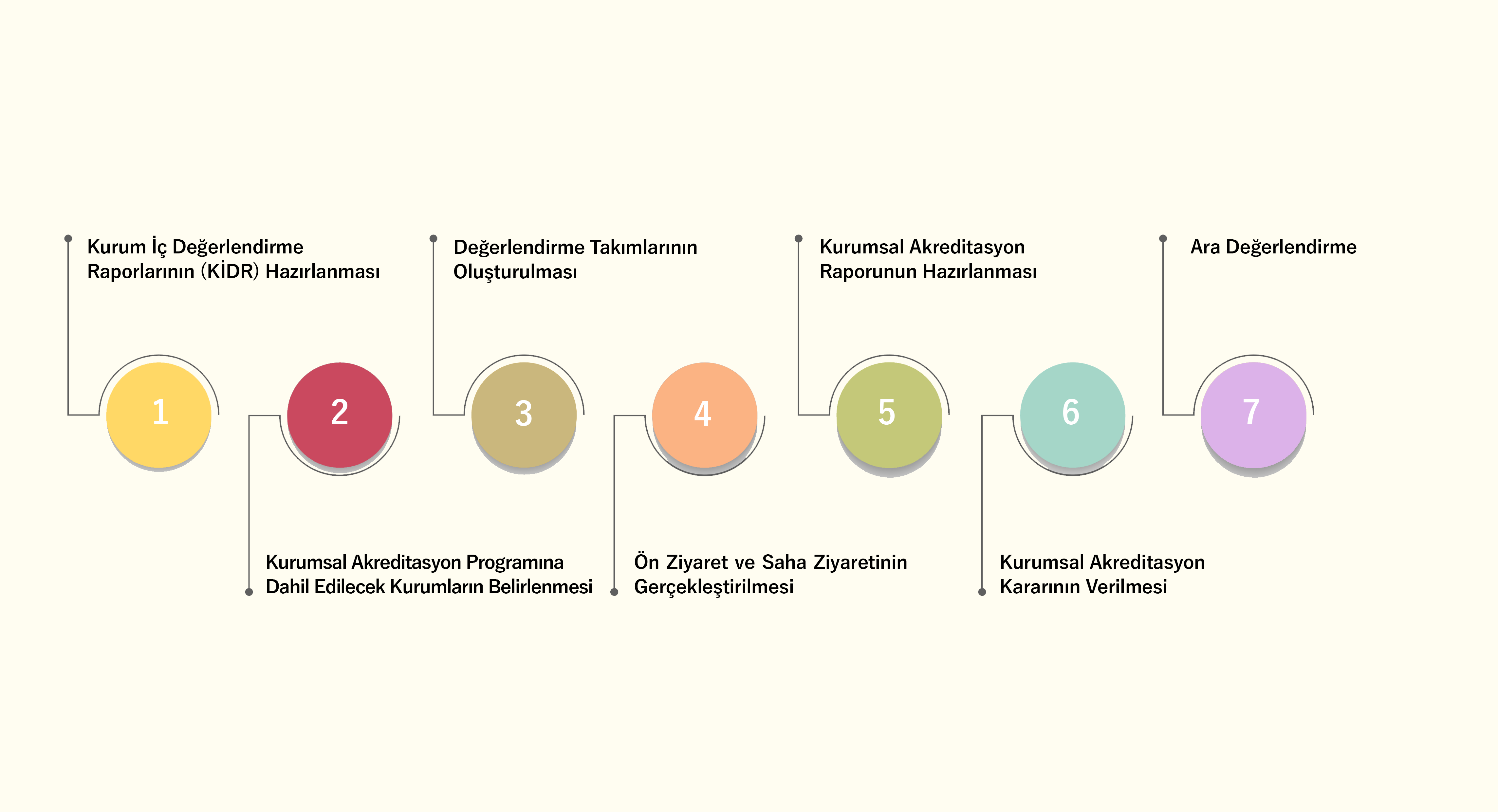
Each year, the higher education institutions to be included in the Institutional Accreditation Programme (IAP) are determined by the Turkish Higher Education Quality Council (THEQC), and evaluation teams are formed in accordance with the structure of these institutions. The evaluation teams pay two visits (a preliminary visit and a site visit) to the institutions concerned.
Following these visits, the evaluation teams prepare Institutional Accreditation Reports, and THEQC makes its accreditation decision on the basis of these reports.
Under the IAP, THEQC issues one of the following decisions:
- Full accreditation (for five years)
- Conditional accreditation (for two years)
- Denial of accreditation